Which Is the Best Polyethylene Coloring Masterbatch in China? The answer depends on application, resin grade, processing temperature, and compliance requirements. A masterbatch that performs well in film may fail in blow molding or injection molding. Color strength alone is not enough.
The market remains substantial. The OECD’s Global Plastics Outlook reported that global plastics production reached 460 million tonnes in 2019. PlasticsEurope’s Plastics—The Fast Facts 2023 recorded 400.3 million tonnes produced globally in 2022. These figures explain the continuing demand for reliable polyethylene coloring masterbatch solutions, especially in packaging, agricultural film, pipes, and household products.
In practical evaluation, buyers should examine pigment dispersion, carrier compatibility, melt flow behavior, heat stability, odor, and color consistency. A useful trial compares the same dosage across several production batches. Small differences can appear as streaks, weak spots, or uneven gloss on a film surface. High pigment concentration sounds efficient. It may also increase dispersion problems if the formulation is poorly balanced. That point deserves more attention.
Leading Chinese suppliers should provide technical data sheets, sample testing, batch traceability, and clear recommendations for let-down ratios. Independent laboratory results can strengthen confidence, particularly for products used near food, toys, or medical packaging. However, certificates alone do not guarantee production performance. Machine settings, recycled content, and resin variability still matter.
This guide compares China’s polyethylene coloring masterbatch suppliers through technical capability, quality control, customization, documentation, and practical value. No ranking is absolute. The best choice is the supplier that proves stable results under your actual processing conditions.
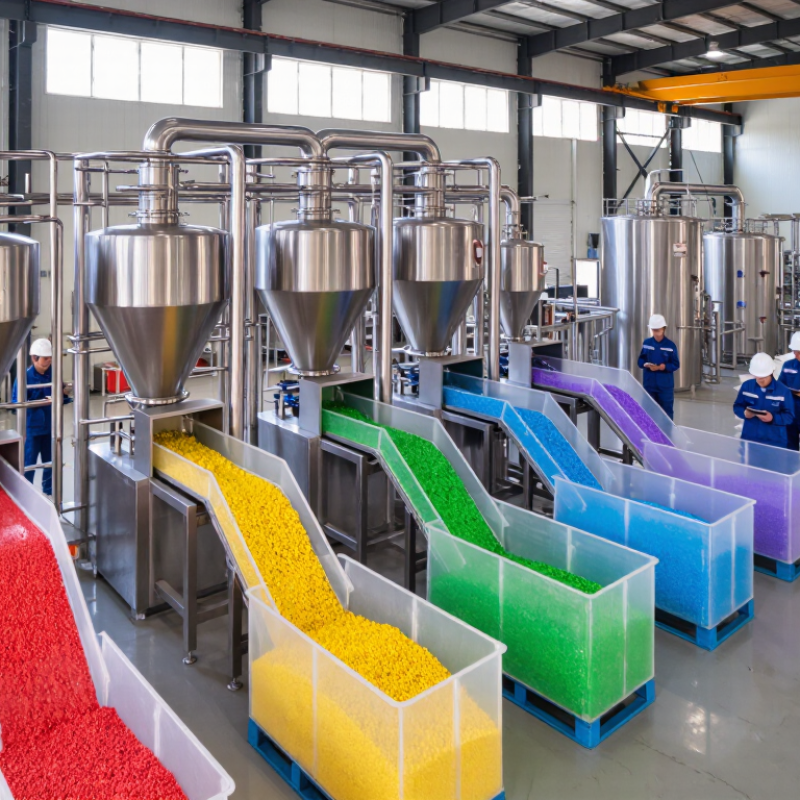
Polyethylene coloring masterbatch is a concentrated mixture of pigments and a compatible polyethylene carrier. It is added to natural polyethylene during extrusion, injection molding, or film production. The carrier helps distribute color evenly through the molten plastic. A well-designed masterbatch should provide strong color, stable processing, and limited impact on melt flow.
Color quality depends on more than pigment strength. Dispersion, heat resistance, moisture control, and dosage accuracy also matter. In production trials, technicians often compare molded plaques, film samples, and pellets under consistent lighting. This reveals streaks, specks, or shade changes that a pellet sample may hide. The pellet can mislead. Testing is essential.
Tips: Ask for pigment details, carrier information, recommended dosage, and processing temperature. Request a sample for your actual polyethylene grade. Check color consistency after repeated extrusion cycles. A spectrophotometer can support visual inspection, but it cannot replace production testing. If the product will contact food, toys, or medical packaging, request current compliance documents for the intended market. Requirements vary by application and country.
When comparing Chinese suppliers, the best option is not always the cheapest or brightest. Reliable technical support, batch consistency, traceable test data, and sensible packaging can reduce production problems. I would also review failed samples instead of judging only successful ones. That step is easy to skip, but it often exposes weak dispersion or unstable coloring. No masterbatch fits every process perfectly. The final choice should follow measured performance in your equipment.
Producing polyethylene coloring masterbatch in China begins with selecting compatible raw materials. Manufacturers usually combine polyethylene carrier resin, organic or inorganic pigments, dispersing agents, and carefully controlled additives. The carrier must match the customer’s processing temperature and final application. Poor compatibility can cause streaks, weak color, or blocked filters.
The ingredients are weighed in a controlled room, then mixed until the pigment spreads evenly. A twin-screw extruder applies heat and shear, turning the blend into a uniform melt. Technicians monitor torque, temperature, pressure, and residence time during production. The melt passes through a die, enters a cooling system, and is cut into small pellets.
Samples are tested for color strength, dispersion, moisture, density, and thermal stability. Experienced producers also compare each batch with an approved reference sample. This step catches subtle shade differences. However, no process is perfect. Pigment variation and seasonal humidity can still affect results, so documented adjustments remain necessary.
Tips: Ask for a technical data sheet and a recent test report. Confirm the carrier resin before ordering. Request a trial sample for your actual polyethylene process. Check the pellets under strong light for dust, uneven color, or visible agglomerates. A lower price may hide higher dosage requirements. Reliable suppliers explain limitations instead of promising identical results for every application.
A high-quality polyethylene coloring masterbatch begins with stable pigment dispersion. Pigments should spread evenly through the carrier resin, without visible specks or streaks. This matters in films, pipes, containers, and molded parts. Uneven dispersion can create weak spots and inconsistent shades. Small details matter.
Carrier compatibility is equally important. The masterbatch should blend smoothly with the selected polyethylene grade and processing temperature. Poor compatibility may cause plate-out, deposits, or blocked filters. Heat stability protects color during extrusion and molding. Light stability helps prevent fading during storage or outdoor use. Moisture control also deserves attention, especially for long production runs.
Reliable suppliers verify performance through controlled testing. Technicians commonly check color difference, dispersion, thermal resistance, migration, and dosing accuracy. Batch-to-batch consistency is critical for manufacturers serving repeat orders. A useful test compares production samples under the same light source and processing conditions. Visual judgment alone can be misleading. No masterbatch is perfect, and a color that looks correct on a test plaque may change in a thin film. That weakness matters. In practice, the best choice depends on resin grade, application, equipment, and required durability. Clear technical data and traceable quality records make that decision more dependable.
Choosing the best polyethylene coloring masterbatch in China requires more than comparing color samples. Top options differ in carrier compatibility, pigment loading, dispersion, and processing stability. A concentrate designed for HDPE may not perform equally in flexible LDPE film.
In practical trials, I compare color strength at the same let-down ratio. I also check melt flow, filter pressure, surface appearance, and shade consistency between batches. Small details matter. A well-dispersed masterbatch should avoid specks, streaks, and die buildup during extrusion. For outdoor products, weathering data and pigment durability deserve close attention. For food-contact or packaging applications, documentation must match the destination market’s requirements.
The strongest suppliers usually provide technical data sheets, safety documents, batch records, and application guidance. They can explain whether the carrier is suitable for injection molding, blow molding, film, or pipe production. I prefer suppliers who recommend a controlled trial instead of promising universal performance. No option wins every application. A low-cost grade may look attractive, yet poor dispersion can increase scrap and cleaning time. I have also seen excellent laboratory samples fail after production-scale processing. That gap deserves honest discussion. Buyers should test the masterbatch with their actual resin, equipment, wall thickness, and processing temperature before making a long-term decision.
| Evaluation Dimension | Option A Standard PE Color Masterbatch |
Option B High-Dispersion PE Masterbatch |
Option C High-Jet Black Masterbatch |
Option D High-Opacity White Masterbatch |
Option E Recycled-PE-Compatible Masterbatch |
|---|---|---|---|---|---|
| Primary Colorant | Organic or inorganic pigments selected for general-purpose shades | Fine-particle organic and inorganic pigments with enhanced dispersion | Carbon black, commonly furnace black or specialty high-jet grades | Titanium dioxide, normally rutile grade for stronger opacity | Pigment package selected for variable recycled-polyethylene feedstock |
| Recommended Carrier | LDPE, LLDPE, or HDPE matched to the processing resin | Low-viscosity PE carrier for rapid melting and pigment wetting | PE carrier with good compatibility with film, pipe, and injection grades | PE carrier with sufficient melt strength for uniform TiO2 distribution | PE or compatible polyolefin carrier suitable for mixed recycled PE |
| Typical Pigment Loading | Approximately 10–40%, depending on color and pigment type | Approximately 20–50%, subject to pigment surface area and shade strength | Approximately 25–50% carbon black | Approximately 50–75% titanium dioxide | Approximately 20–60%, adjusted for recycled-resin variability |
| Normal Addition Rate | 1–4% for standard shades | 0.5–3% when strong dispersion and shade consistency are achieved | 0.5–2.5%, depending on required blackness and opacity | 2–8%, depending on film thickness, background color, and opacity target | 1–5%, usually verified by trial because recycled resin color varies |
| Color Strength | Good for routine colors and medium-depth shades | Very good, particularly for transparent, light, and high-chroma shades | Very high blackness and tinting strength | High whiteness and opacity when sufficient loading is used | Good, but final shade depends strongly on recycled-feedstock color |
| Dispersion Performance | Good under correctly matched processing conditions | Excellent; designed to reduce streaks, specks, and shade variation | Very good, although carbon black requires adequate shear and mixing | Good to very good; excessive TiO2 loading can increase dispersion difficulty | Good when the formulation is matched to the recycled material and filtration system |
| Heat Stability | Typically suitable for PE processing temperatures of about 160–230°C | Typically suitable for about 180–260°C, subject to pigment selection | Generally excellent thermal stability for common PE applications | Generally good to excellent; rutile TiO2 is preferred for demanding applications | Typically suitable for about 180–240°C, depending on recycled contaminants |
| Weathering Resistance | Basic to good; must be confirmed for outdoor exposure | Good when lightfast pigments and UV stabilizers are specified | Excellent for many outdoor products because carbon black provides strong UV protection | Good to excellent with suitable TiO2 surface treatment and UV protection | Moderate to good; recycled-resin oxidation history should be evaluated |
| Best-Fit Applications | General packaging, household products, injection molding, and extrusion | Thin films, multilayer films, technical parts, and appearance-critical products | Agricultural film, pipes, garbage bags, automotive parts, and outdoor products | White film, containers, caps, geomembranes, and opaque molded products | Recycled PE bags, pallets, bins, non-food packaging, and utility products |
| Main Advantage | Balanced performance and economical processing | Low addition rate and consistent visual quality | Maximum blackness, UV resistance, and strong coverage | High opacity and clean, bright white appearance | Better shade control for variable recycled-polyethylene inputs |
| Key Limitation | May require a higher dosage for very bright or highly opaque shades | Usually has a higher unit cost than standard formulations | Can reduce surface gloss or affect electrical properties at high loading | Higher loading may increase melt viscosity, filtration demand, and cost | Final color consistency is limited by contamination and feedstock variation |
| Overall Suitability | Best for cost-sensitive, general-purpose PE coloring | Best for demanding appearance and dispersion requirements | Best for deep black color and outdoor durability | Best for high-opacity white products | Best for products using recycled PE or mixed recycled feedstock |
Note: Performance ranges are typical industry values for polyethylene masterbatch formulations. Actual results depend on pigment chemistry, carrier resin, processing temperature, equipment, film or part thickness, and the final application requirements.
Choosing the best polyethylene coloring masterbatch starts with the application, not the brightest color sample. A buyer should confirm the polyethylene grade, processing temperature, film thickness, and required color strength. Compatibility matters. A masterbatch designed for high-density polyethylene may behave differently in low-density polyethylene. Melt flow index should also match the production process. Poor matching can cause uneven dispersion, die lines, or unstable feeding.
Request a technical data sheet, safety documentation, pigment information, and recent batch records. Reliable suppliers should explain pigment loading, carrier resin, heat resistance, light resistance, and recommended addition rates. Ask for a small production trial, not only a laboratory plaque. Check the first meters, the middle of the run, and the final roll. I have seen attractive samples fail during longer extrusion because the shade slowly drifted. That weakness is easy to miss.
Tips: Compare samples under the same lighting. Test at the actual processing temperature. Measure color with instruments when possible. Inspect surface appearance and filter pressure. Keep a retained sample from every approved batch. Do not choose by price alone. The lowest-cost option may require more dosage or create costly cleaning work. Still, even a detailed test cannot predict every factory condition, so buyers should review results with operators and remain willing to adjust the specification.
Manufacturers combine polyethylene carrier resin, pigments, dispersing agents, and controlled additives.
Poor compatibility may cause streaks, weak color, blocked filters, or unstable processing.
Ingredients are weighed, mixed, heated, and sheared inside a twin-screw extruder.
The molten material passes through a die, cools, and becomes small pellets.
Samples are checked for color strength, dispersion, moisture, density, and thermal stability.
View them under strong light. Look for dust, uneven color, or visible agglomerates.
No option works everywhere. A grade for rigid polyethylene may perform poorly in flexible film.
Use the same let-down ratio, resin, equipment, wall thickness, and processing temperature.
Higher dosage, scrap, die buildup, or cleaning time may erase the initial savings.
Not always. Production trials can reveal shade changes, pressure increases, or dispersion problems.
Polyethylene Coloring Masterbatch is a concentrated blend of pigments, additives, and polyethylene-based carrier resin used to provide consistent color during plastic processing. In China, it is typically produced through pigment dispersion, high-speed mixing, extrusion, cooling, and pelletizing. The quality of the final product depends on factors such as color strength, dispersion uniformity, heat stability, migration resistance, compatibility with the target polyethylene, and processing consistency. A well-made masterbatch should reduce pigment usage, minimize defects, and maintain stable color across different production batches.
When comparing masterbatch options, buyers should consider the intended application, processing temperature, required color accuracy, dosage rate, packaging, storage conditions, and technical support. Testing samples under real production conditions is essential for evaluating performance, surface appearance, mechanical impact, and long-term color stability. The best choice is not always the lowest-priced option, but the one that offers reliable quality, efficient processing, consistent supply, and suitability for the buyer’s specific polyethylene products.