Why Choose High Concentration PE Masterbatch? The answer begins with control, not simply color strength. High Concentration PE Masterbatch contains a larger pigment or additive load in a polyethylene carrier. This can reduce dosage, storage space, and handling steps on busy production floors.
Grand View Research values the global masterbatch market at more than USD 11 billion, with continued growth projected through 2030. Its analysis links demand to packaging, agriculture, construction, and consumer products. Smithers’ masterbatch market studies also identify advanced concentrates as important for efficient processing and consistent performance. These reports suggest a practical direction. Less material handling can support leaner operations.
Still, concentration alone proves nothing.
Poor dispersion may create streaks inside a thin film. An incompatible carrier can weaken sealing or change melt behavior. A trial batch should therefore examine color strength, filtration pressure, tensile performance, and odor. A technician should inspect the film under strong side lighting, not only trust the color card.
Patrick Thomas, former Covestro chief executive and a respected plastics-industry leader, said, “There is no such thing as a sustainable plastic, only a sustainable use of plastic.” His warning fits this decision. A concentrated masterbatch may lower material consumption, yet over-dosing can erase that advantage.
The right choice depends on resin grade, processing temperature, screw design, and end-use requirements. It also depends on supplier transparency. Technical data sheets, batch records, and migration documentation matter.
The perfect concentrate does not exist.
Manufacturers should compare real production results, not impressive percentages alone. That is where High Concentration PE Masterbatch earns its value: stable output, measurable efficiency, and fewer surprises.
What Is High Concentration PE Masterbatch?
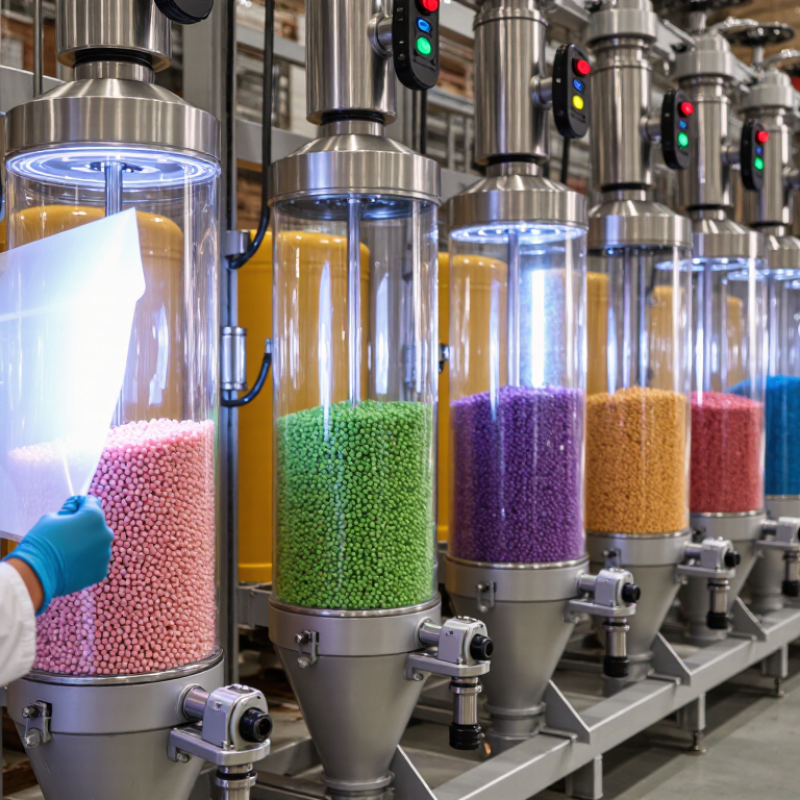
High-concentration PE masterbatch is a pelletized mixture designed for coloring or modifying polyethylene products. It contains a high level of pigment, additive, or functional powder inside a compatible polyethylene carrier. During processing, the carrier melts and distributes the concentrated ingredients through the base resin.
It sounds simple. But concentration alone does not guarantee performance. A technician may blend one kilogram of masterbatch with 20 to 50 kilograms of natural polyethylene, depending on the required shade or property. Film, injection molding, and extrusion applications may need different formulations. The correct carrier resin also matters because poor compatibility can cause streaks, specks, or uneven surfaces.
In production trials, engineers usually check color consistency, melt flow, dispersion, filter pressure, and mechanical strength. A small sample can reveal problems before a full production run. High pigment loading can reduce handling costs and simplify storage, but highly loaded pellets may disperse less easily. This limitation is often overlooked. Processing temperature, screw design, and mixing time can change the final result. Even a well-formulated masterbatch needs practical testing with the actual polyethylene grade and equipment.
Why Choose High Concentration PE Masterbatch?
What Is High Concentration PE Masterbatch?
High concentration PE masterbatch contains a higher proportion of pigment or additive dispersed in a polyethylene carrier. The chart shows the calculated masterbatch addition needed to achieve a 1% final pigment concentration at different concentrate loadings.
Calculation: required masterbatch addition (%) = target pigment concentration (%) ÷ pigment concentration in masterbatch (%). Actual dosage may vary with pigment type, dispersion quality, carrier compatibility, and processing conditions.
How Does High Concentration PE Masterbatch Work?
Why Choose High Concentration PE Masterbatch?
How Does High Concentration PE Masterbatch Work?
High concentration PE masterbatch contains a large amount of pigment or functional additive in a compatible polyethylene carrier. During production, controlled heat softens the carrier and helps distribute each particle through the polymer. Strong mixing is essential. Poor dispersion can create streaks, weak spots, or uneven color.
Processors usually blend a small amount of masterbatch with natural polyethylene pellets. The final dosage depends on the desired shade, additive level, equipment, and product thickness. In an extruder, rotating screws generate heat and shear. These forces break up agglomerates and spread the concentrate through the melt. The blended material then forms film, pipe, packaging, or molded parts.
Small details matter. Moisture, barrel temperature, screw design, and feeding accuracy can change the result. A stable formula may still perform poorly when the processing window is too narrow. Testing at the actual production speed is therefore more reliable than judging a sample by appearance alone. It is not magic. Better dispersion often requires adjustment, and even experienced operators can miss a variable. A simple trial can reveal more than a confident assumption.
What Benefits Does It Offer in Plastic Manufacturing?
High concentration PE masterbatch offers a practical way to improve color and additive dosing in plastic manufacturing. It contains a higher pigment or additive load than standard formulations. This means less masterbatch is needed for the same effect. In a busy extrusion line, fewer bags can simplify material handling and reduce storage pressure.
Plastics Europe reported 413.8 million tonnes of global plastics production in 2023. At this scale, small efficiency gains can affect production costs and transport emissions.
Consistent dispersion is another important benefit. A well-designed PE carrier helps pigments distribute evenly through the melt. Operators may see fewer streaks, shade changes, and rejected rolls. Lower addition rates can also preserve more of the base resin’s mechanical properties.
The OECD’s Global Plastics Outlook projects plastic use could rise from 460 million tonnes in 2019 to 1.23 billion tonnes by 2060 without stronger measures. Better material efficiency will therefore matter more, not less.
Still, concentration alone is not magic.
Processing conditions remain critical.
Excessive screw speed, poor temperature control, or weak mixing can create agglomerates. In practical trials, a masterbatch may perform well in one film line but poorly in another. Melt flow, let-down ratio, moisture control, and resin compatibility should be checked before full-scale production. A lower dosage can reduce packaging waste, but inaccurate feeding can erase that advantage. The most reliable approach combines supplier technical data, laboratory testing, and production-floor observation.
Small mistakes are expensive.
Which Applications Use High Concentration PE Masterbatch?
High concentration PE masterbatch is used across many polyethylene processing applications. Packaging film is one of the largest areas. Blown film producers use it for bags, liners, shrink film, and food packaging structures. A concentrated formulation can reduce storage space and support accurate dosing during continuous production.
Injection molding is another practical application. Containers, caps, household boxes, and industrial parts often require stable color or functional additives. Blow molding operations also use PE masterbatch for bottles, tanks, and larger hollow products. Agricultural films may use masterbatch for color, light management, or weathering support. Pipe compounds and rotationally molded products can also benefit when the carrier matches the base resin.
Tips: Check carrier compatibility, pigment dispersion, dosing accuracy, and melt temperature before full production. Run a small trial with the actual PE grade. Film thickness can expose weak dispersion quickly. A good masterbatch is not automatically suitable everywhere. This is where some projects go wrong. Processing speed, screw design, and recycled content can change the final result. Keep records of dosage, batch temperature, and visual defects. Those details help technicians adjust the formulation with evidence, rather than guesswork. Supplier test data is useful, but factory trials remain essential.
Why Choose High Concentration PE Masterbatch? - Which Applications Use High Concentration PE Masterbatch?
| Application |
Typical PE Resin |
Common Masterbatch Addition Rate |
Why High Concentration Is Preferred |
Key Performance Considerations |
| Blown Film Packaging |
LDPE, LLDPE, or blends |
1%–4% |
Delivers strong color or additive performance with less carrier material, helping reduce formulation volume and material handling. |
Dispersion, film uniformity, sealability, coefficient of friction, and haze. |
| Stretch Film |
LLDPE |
0.5%–2% |
A concentrated formulation can support consistent tinting or additive dosing while helping preserve stretch and load-holding properties. |
Tensile strength, elongation, cling, puncture resistance, and optical clarity. |
| Agricultural Film |
LDPE, LLDPE, or metallocene PE |
1%–5% |
Provides an efficient way to incorporate UV stabilizers, infrared additives, or colorants into large-volume film production. |
Weathering resistance, additive compatibility, light transmission, and long-term dispersion stability. |
| Garbage and Industrial Bags |
HDPE, LDPE, or LLDPE |
1%–4% |
High pigment or additive loading can provide strong coverage and consistent appearance at a relatively low let-down ratio. |
Opacity, tear strength, impact resistance, drawability, and odor control where applicable. |
| Injection-Molded PE Products |
HDPE or MDPE |
1%–3% |
Reduces the amount of carrier introduced into the formulation and supports repeatable color dosing across production batches. |
Melt flow, mold filling, shrinkage, surface appearance, and pigment migration. |
| Blow-Molded Containers |
HDPE or MDPE |
1%–4% |
Concentrated color systems help achieve uniform wall coloration without significantly changing the base resin formulation. |
Melt strength, parison stability, color dispersion, wall-thickness consistency, and stress cracking resistance. |
| Woven Sacks and Raffia |
PP is most common; PE grades may also be used |
1%–3% |
A suitable high-concentration system can improve dosing efficiency and color consistency in tapes and woven structures. |
Draw ratio, tensile strength, tape breakage, pigment dispersion, and thermal stability. |
| Pipe and Profile Extrusion |
HDPE or MDPE |
1%–5% |
Enables stable color or additive incorporation during continuous extrusion and may simplify inventory management. |
Pressure stability, surface finish, dimensional control, pigment weathering, and long-term material compatibility. |
Note: Actual addition rates depend on pigment loading, additive type, desired color strength, resin grade, processing temperature, equipment design, and required end-use performance. Compatibility and dispersion should be validated through production trials.
How Should Manufacturers Select and Process It?
High concentration PE masterbatch can reduce storage space, handling effort, and color variation. Its value depends on correct selection, not only pigment loading. Manufacturers should match the carrier resin with the target polyethylene grade. Check melt flow index, processing temperature, and final product requirements. A mismatch may cause streaks, poor dispersion, or unstable feeding.
Review the technical data sheet and request a small production trial. Confirm pigment compatibility, moisture level, recommended let-down ratio, and additive content. Experienced operators also inspect pellets for dust and irregular shapes. These details affect feeder accuracy. Keep the masterbatch sealed and dry before use. Moisture can create bubbles or surface defects. It sounds basic, but storage is often overlooked.
During processing, begin with the supplier’s temperature range and adjust gradually. Excessive heat can damage sensitive pigments or additives. A clean screw and steady feeding speed support uniform dispersion. Record actual output, pressure, color, and surface appearance. I have seen good formulations fail because the feeder was poorly calibrated. Perfect settings rarely exist. A short trial may reveal unexpected behavior. If streaks appear, check feeding, mixing, and contamination before changing the formula. Manufacturers should also compare samples after cooling, because color can shift slightly between melt and finished parts.
Conclusion
High Concentration Pe Masterbatch is a concentrated blend of polyethylene resin and carefully selected additives or pigments, designed to improve the efficiency and consistency of plastic production. During processing, it is mixed with a base polymer at a controlled ratio, allowing the active components to disperse evenly throughout the final product. This approach helps manufacturers achieve stable color, enhanced material performance, and accurate additive distribution while reducing storage and handling requirements.
Its benefits include lower transportation costs, improved production flexibility, reduced waste, and more consistent product quality. High Concentration Pe Masterbatch is commonly used in films, packaging bags, containers, pipes, agricultural products, and various molded plastic items. Manufacturers should select a grade that matches the base resin, processing temperature, required color or function, and end-use performance. Proper dosing, thorough mixing, and suitable processing conditions are also essential for achieving reliable results and avoiding defects such as poor dispersion or uneven coloring.