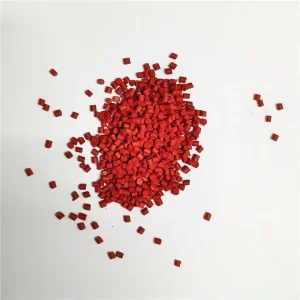
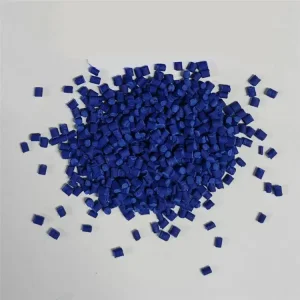
Explore our specialized carrier-matched PE masterbatch grades formulated for extreme thermal resistance, zero migration, and high-speed jacket extrusion.
Understanding the shift toward high-density (HDPE), medium-density (MDPE), and linear low-density (LLDPE) jacket compounds in global wire and cable infrastructure.
The global rollout of Fiber-To-The-Home (FTTH) and 5G network backhauls requires specialized micro-duct and direct-burial optical cable jackets. Polyethylene cable sheath masterbatch must deliver exceptional Environmental Stress Crack Resistance (ESCR) alongside microscopic pigment particle dispersion to prevent signal attenuation caused by sheath micro-deformations.
Utility providers in North America, Europe, and Asia are modernizing aging grids to handle intermittent renewable energy from wind and solar farms. High-voltage (HV) subterranean and subsea cables demand cable sheathing compounds featuring ultra-pure P-type carbon black masterbatches to guarantee 30+ years of operational weatherability and thermal stability.
International OEMs face rigorous compliance constraints including EN 50290, IEC 60502, REACH SVHC, and RoHS 3 directives. Masterbatch factories are forced to eliminate heavy metals, low-molecular-weight waxes, and halogenated additives, driving rapid adoption of non-toxic, eco-compatible carrier resins and functional additive packages.
How specialized custom PE cable sheath masterbatch manufacturers optimize carrier compatibility, prevent agglomeration, and ensure superior dielectric performance.
Standard masterbatches engineered for blown film or injection molding frequently use high melt-flow-index (MFI) wax carriers or coarse pigment grades. When applied to cable sheathing, these low-cost carriers migrate to the jacket surface, causing severe Environmental Stress Cracking (ESC), lowering dielectric breakdown voltage, and promoting moisture absorption. True cable-grade masterbatch uses fractional MFI LLDPE/HDPE matrix carriers perfectly rheologically matched to the base jacketing compound.
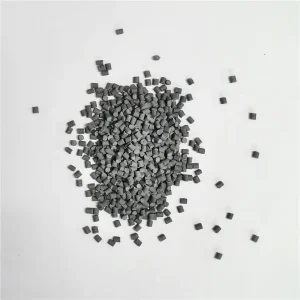
For black PE cable jackets, primary carbon black particle size must be maintained strictly between 19nm and 25nm with a toluene extractable level below 0.03%. P-Type furnace carbon black provides optimal UV absorption across the 290–400nm solar spectrum without degrading the mechanical ductility of the polyethylene matrix.
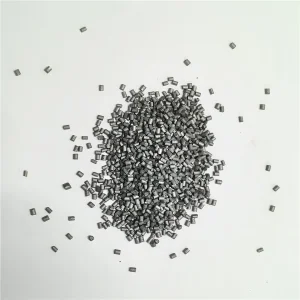
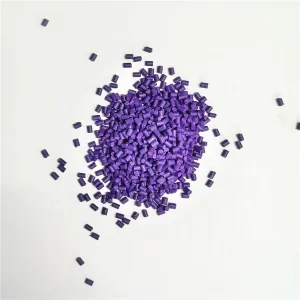
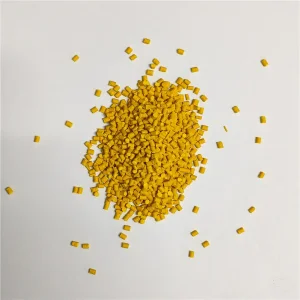
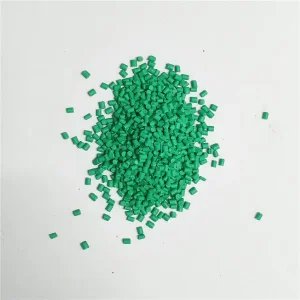
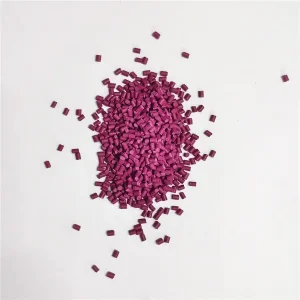
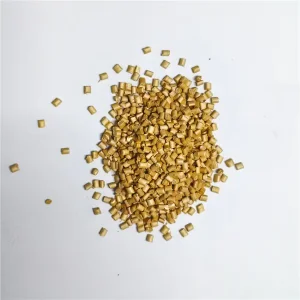
For colored PE cable jacketing (e.g., Telecom yellow, orange, silver, red), UV resistance cannot rely on carbon black. Masterbatch suppliers incorporate high-molecular-weight HALS (such as Chimassorb 944 / Tinuvin 622 blends) alongside primary phenolic antioxidants (Irganox 1010) to trap free radicals generated by photo-oxidation.
Industrial extruders operate at high line speeds (> 100 m/min). Masterbatch agglomerates larger than 15 microns cause surface pinholes and die drool. Advanced compounding utilizes high-intensity continuous co-kneaders, ensuring a Filter Pressure Value (FPV) under 0.5 bar/g through a 140-mesh screen pack.
| Performance Metric | Standard Masterbatch | PE Cable Sheath Masterbatch (Jiazhou Grade) | Testing Standard |
|---|---|---|---|
| Carrier Resin Match | Homo-PP / High MFI PE Wax | Fractional MFI LLDPE / HDPE (MFI < 0.7 g/10min) | ASTM D1238 |
| Carbon Black Dispersion Index | Category 3–4 (Agglomerates present) | Category 1 (< 5 micron mean particle spread) | ISO 18553 / IEC 60811-401 |
| Oxidative Induction Time (OIT at 200°C) | < 15 minutes | > 55 minutes | ASTM D3895 / EN 728 |
| Environmental Stress Crack Resistance | F50 < 100 Hours | F50 > 1000 Hours (No cracks) | ASTM D1693 (Condition B) |
| Dielectric Strength | 18–22 kV/mm | > 32 kV/mm | IEC 60243-1 |
Custom masterbatch formulations tailored to extreme weather, aggressive chemical environments, and specific structural cable requirements.
Industrial Challenge: Direct burial exposes cable jackets to microbial attack, subterranean humidity, soil acidic variation, and heavy physical shear from soil shifting.
Custom Solution: Masterbatch formulated with synergistic hydrophobic anti-fungal agents, fine-particle carbon black, and high-density polyethylene carriers. This creates a dense crystalline outer barrier that prevents moisture ingress and resists mechanical abrasion during underground pipe-pulling operations.
Industrial Challenge: Solar farm interconnect cables operate under persistent solar radiation and ambient temperatures reaching +85°C, causing premature jacket embrittlement.
Custom Solution: Incorporating combined UV absorber/HALS stabilization packages with color-stable inorganic pigments (such as PE Silver, Red, and Yellow masterbatches). Exceeds 3,000 hours of artificial weathering under ISO 4892-2 testing with delta E color shift under 1.5.
Industrial Challenge: High hydrostatic pressures combined with continuous saltwater exposure can cause micro-voids in cheap masterbatches, leading to water treeing in high-voltage subsea cables.
Custom Solution: Double-filtered ultra-clean PE sheath masterbatch processed on vacuum-degassed co-rotating twin-screw extruders. Voids and volatile organic compounds (VOCs) are completely eliminated, guaranteeing zero dielectric void formation.
Industrial Challenge: Subterranean rodents and termites routinely destroy fiber-optic lines in tropical and arid agricultural zones.
Custom Solution: Multifunctional PE sheath masterbatch integrating non-toxic bittering additives (Denatonium Benzoate) or synthetic pyrethroid repellent compounds directly co-compounded with pigment systems, eliminating the need for expensive secondary metal armor tape.
Pioneering eco-friendly, nano-enhanced, and intelligent sensing polymer colorants for next-generation global power and telecommunication grids.
Developing 100% circular PE masterbatch carriers derived from sugar-cane ethylene and certified ISCC PLUS mass-balance PCR polyethylene. Formulations focus on maintaining high OIT values despite reprocessed carrier matrices.
Embedding functional graphene nanoplatelets within the PE black masterbatch to increase the thermal conductivity of outer cable jackets. This allows high-voltage cables to dissipate heat faster, increasing power transmission capacity by up to 12% without increasing core conductor size.
Integrating micro-encapsulated healing agents and thermochromic indicators into the PE jacket compound. Cable jackets will automatically seal minor surface micro-cracks while providing visual color changes at points of localized thermal overload or partial discharge faulting.
Expert insights from our polymer engineers on masterbatch selection, dosing ratios, processing parameters, and quality assurance.
Essential quality metrics and factory capabilities buyers must verify prior to high-volume procurement.
Verify that the factory operates differential scanning calorimetry (DSC) equipment to test Oxidative Induction Time (OIT) on every production batch. Ensure Capillary Rheometers are used to verify shear-viscosity curve alignment with customer base resins.
Standard twin-screw extruders often fail to disperse ultra-fine pigments without overheating the polymer matrix. Premium suppliers utilize continuous co-kneaders (Buss-type kneaders) offering low shear stress combined with high distributive mixing capabilities.
Every shipment must be backed by a comprehensive Certificate of Analysis (COA) specifying MFI, moisture content, FPV value, and density. Production lots must retain 3-year physical retain samples for full supply-chain traceability.
Click any product below to view detailed specifications, technical datasheets (TDS), and request factory-direct quotations.
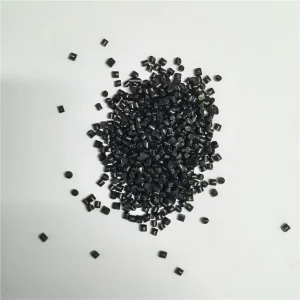
High-Quality High Concentration PE Black Masterbatch Eco-friendly 260°C Heat Resistant
Request Quote