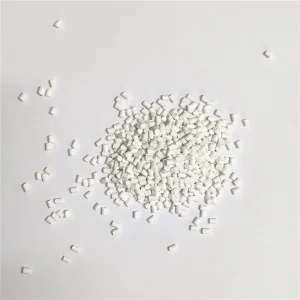
Modern commercial agriculture relies on multi-layer co-extruded polyolefin films (LLDPE, LDPE, EVA, mLLDPE) to engineer controlled microclimates for high-yield crop production. The foundational pillar of high-performance greenhouse film manufacturing lies in the chemistry and dispersion mechanics of Weather Resistant White Masterbatch. Acting as more than a simple opaque colorant, a high-grade white masterbatch must regulate solar radiation, diffuse Photosynthetically Active Radiation (PAR), shield crops from destructive ultraviolet (UV) bandwidths, and maintain structural integrity against severe photo-oxidative degradation.
Core Industry Paradigm Shift: Modern agricultural film extrusion is transitioning from basic opacity additives toward multi-functional photothermal concentrates. Premium white masterbatches now integrate passivated Rutile Titanium Dioxide ($TiO_2$), Hindered Amine Light Stabilizers (HALS), UV absorbers, and anti-antioxidant packages within tailored linear low-density polyethylene (LLDPE) carrier resins.
Standard titanium dioxide possesses photo-catalytic activity when exposed to UV radiation (290–400 nm). Under solar excitation, electron-hole pairs are created, producing free radicals that break the polymer matrix chains. High-end greenhouse white masterbatch utilizes chloride-process Rutile $TiO_2$ encapsulated with dense silica ($SiO_2$) and alumina ($Al_2O_3$) inorganic surface coatings, effectively neutralizing photocatalytic degradation.
By controlling the particle size distribution of Rutile $TiO_2$ at an optimized mean diameter of $0.25$ to $0.35$ microns, white masterbatch achieves maximum light scattering efficiency according to Mie Scattering Theory. Diffused light penetrates deeper into crop canopies without scorching upper leaves, reducing greenhouse hotspot stress and optimizing photosynthetically active light utilization.
Sulfur, chlorine, and halogenated pesticides used in intensive agriculture rapidly deactivate standard HALS additives. Advanced weather-resistant white masterbatch formulations incorporate high-molecular-weight NOR-type HALS and metal carboxylate neutralizers, preserving film elasticity, tensile strength, and optical opacity over multi-season exposure cycles.
| Property Parameter | Standard Commercial Grade | Jiazhou Weather-Resistant Grade | Testing Protocol / Standard |
|---|---|---|---|
| Titanium Dioxide ($TiO_2$) Content | 40% – 50% Anatase / Low-Rutile | 60% – 70% Pure Rutile (Chloride Process) | ISO 3451-1 / TGA Analysis |
| Carrier Resin Matrix | Recycled / Generic LLDPE | 100% Virgin LLDPE (MFI 2.0 - 20 g/10min) | ASTM D1238 |
| Filter Pressure Value (FPV) | > 2.5 bar/g | < 0.5 bar/g (25 micron mesh) | EN 13900-5 |
| Heat Resistance / Thermal Stability | Up to 220°C | 260°C – 300°C (No Discoloration) | DIN EN 12877-2 |
| Artificial Weathering Resistance | < 1,000 Hours QUV | > 5,000 Hours Xenon Arc / QUV-B | ASTM G154 / ISO 4892-2 |
| Yellowing Index (YI) Stability | $\Delta YI > 8.0$ after 1yr | $\Delta YI < 1.5$ after 3yrs | ASTM E313 |
For agricultural film converters, film blowers, and greenhouse masterbatch buyers, selecting a reliable manufacturing factory requires balancing initial resin concentrate costs against processing efficiency, film yield, and field performance guarantees. Subpar masterbatches lead to catastrophic field degradation, bubble instability during high-speed blowing, filter clogging, and severe customer claims.
In blown films as thin as 15 to 50 microns (such as greenhouse mulch or double-layer shading covers), un-dispersed $TiO_2$ agglomerates create stress concentration points and micro-pinholes. Procurement teams must audit suppliers for twin-screw compounding torque, loss-in-weight feeding accuracy, and sub-micron screenpack filtration to guarantee seamless high-speed film blowing without line breaks.
A common failure in white agricultural film is "pinking" or "yellowing" caused by complexation between titanium ions, sterically hindered phenolic antioxidants, and airborne nitrogen oxides ($NO_x$) or soil sulfur gas. Professional factories utilize gas-fading resistant additive matrices to ensure that white films retain clean opacity and neutral color during warehouse storage and field service.
As global demand for high-durability agricultural plastics expands, China's masterbatch manufacturing sector has transformed into an automated, highly integrated supply chain hub. Operating from Changzhou, Jiangsu Province, Changzhou Jiazhou Plastic Products Co., Ltd. exemplifies the modern China Industry 4.0 paradigm, combining 16 years of polymer modification expertise with ultra-modern processing infrastructure.
Equipped with high-torque twin-screw extruders featuring L/D ratios of 48:1 to 56:1, multi-stage melt feeding, and side-feeders for volatile additive protection. This guarantees 100% encapsulation of $TiO_2$ particles within the PE carrier, maximizing tinting strength and minimizing melt fracture.
Jiazhou operates a streamlined 6,000 m² production workshop incorporating automated bulk raw material conveyancing, gravimetric dosing systems, and precision colorimetric quality inspection labs operating round-the-clock for batch consistency.
Strategic co-location with world-class Titanium Dioxide refiners ensures guaranteed access to premium chloride-grade Rutile raw materials, insulating global buyers from chemical market volatility and delivering exceptional price-to-performance advantages.
Agricultural macro-trends vary sharply across global regions. High-quality weather resistant white masterbatch formulations must be localized to match solar radiation intensities (measured in Kly/year), local crop profiles, and structural greenhouse designs.
Solar radiation exceeds 180–220 Kly/year. White masterbatch must feature maximum $TiO_2$ loading combined with nickel quenchers or heavy HALS stabilization to prevent rapid embrittlement under intense desert radiation.
Focuses on high light diffusion to prevent sun-scorch on soft fruits, tomatoes, and florals. Formulations blend Rutile $TiO_2$ with inorganic light scattering agents to maximize diffuse light transmission above 60%.
High humidity and intensive sulfur burning for pest control in flower and banana plantations require acid-resistant HALS systems integrated directly within the white masterbatch matrix.
Commercial greenhouse operations demand 3-to-5 year multi-season film guarantees. Requires ultra-pure virgin LLDPE masterbatches with near-zero volatile organic compounds (VOCs) and flawless filterability.
Agricultural films serve highly specialized structural roles across the farming ecosystem. Jiazhou's weather-resistant white masterbatch portfolio is tailored to specific blown film co-extrusion layers (A/B/C structure):
In 3-layer or 5-layer co-extruded greenhouse films, the outer layer is continuously exposed to raw solar radiation and atmospheric oxygen. Incorporating 5% to 10% Jiazhou Weather-Resistant White Masterbatch into the outer LLDPE layer provides maximum $TiO_2$ UV reflection, protecting interior layers containing expensive thermal IR absorbers and anti-dripping surfactants from premature photolysis.
Panda films feature a white top layer to reflect excess solar thermal energy and cool plant root zones, paired with a black bottom layer containing high-jetness Carbon Black to suppress weed growth. Jiazhou's high-opacity white masterbatch delivers total opacity at thin gauge ($10-15 \mu m$), preventing light bleed through to the black substrate layer.
Silage films require high elongation at break, tear strength, and airtight oxygen barriers to facilitate anaerobic forage fermentation. Our white masterbatches utilize narrow molecular weight distribution virgin PE carriers that preserve film stretchability while maintaining complete white opacity against solar heating.
Liners used in agricultural irrigation ponds and hydroponic channels require non-toxic, RoHS/REACH compliant colorants that will not leach heavy metals or inorganic fillers into crop water systems. Jiazhou masterbatches pass stringent environmental testing for aquatic safety.
Answers to crucial engineering, quality assurance, and manufacturing queries regarding greenhouse film weather-resistant white masterbatch sourcing.
Rutile $TiO_2$ possesses a denser tetragonal crystal structure with a higher refractive index (2.73) compared to Anatase (2.55). This gives Rutile significantly superior light scattering efficiency, opacity, and tinting strength. More importantly, Anatase possesses high photochemical activity that accelerates polymer degradation under UV light, whereas surface-treated Rutile provides strong UV absorption and weatherability essential for long-term outdoor exposure.
"Pinking" or phenolic gas fading occurs when un-passivated titanium ions on $TiO_2$ particles interact with sterically hindered phenolic antioxidants (commonly added during base polymer synthesis) and atmospheric nitrogen oxides ($NO_x$). Jiazhou prevents this reaction by utilizing double-coated inorganic ($SiO_2/Al_2O_3$) Rutile grades and incorporating proprietary non-phenolic thermal processing stabilizers into the masterbatch matrix.
Filter Pressure Value (tested under EN 13900-5) measures the dispersion quality of pigments in molten plastic. High FPV values indicate $TiO_2$ agglomerates or impurities that quickly clog melt screenpacks, causing extrusion pressure spikes, die lines, and film bubble instability. Jiazhou's weather-resistant white masterbatch achieves an FPV of less than 0.5 bar/g, permitting uninterrupted high-speed extrusion through fine 25-micron screenpacks.
Depending on the final film thickness and desired opacity/UV lifetime, standard Let-Down Ratios range from 2% to 10%. For heavy-duty 150–200 micron multi-span greenhouse covers, an LDR of 4% to 6% of a 70% concentrated Rutile masterbatch delivers optimal balance between opacity, PAR light diffusion, and cost control.
Yes. To maintain mechanical toughness and prevent layer delamination in co-extruded films, the masterbatch carrier resin should closely match the base film matrix. Jiazhou formulates custom white concentrates using specialized low-density polyethylene (LDPE), LLDPE, mLLDPE, or Ethylene-Vinyl Acetate (EVA) carrier resins tailored to customer extrusion specifications.
Sulfur burn treatments generate acidic vapors ($SO_x$) that penetrate polyolefin film and deactivate conventional basic HALS light stabilizers, triggering rapid photo-oxidation. Jiazhou's weather-resistant white masterbatch can be compounded with specialized acid-resistant HALS (NOR-HALS) and metal oxide scavengers to neutralize pesticide corrosion and extend film lifespan up to 36–48 months.
High moisture levels (> 0.15%) cause steam vaporization during extrusion, resulting in lens defects, pinholes, bubble pops, and reduced tensile strength in agricultural films. Jiazhou masterbatches undergo automated desiccant conditioning and low-temperature vacuum packing to ensure moisture content remains strictly below 0.05% (500 ppm) upon delivery.
Every production batch undergoes a 6-point QC protocol: Melt Flow Index (MFI) verification, 25-micron Filter Pressure Value (FPV) testing, Datacolor Spectrophotometer CIELAB color-matching ($\Delta E < 0.5$), moisture titration, ash content analysis, and high-speed pilot blown film sample extrusion.