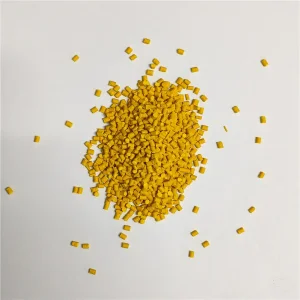
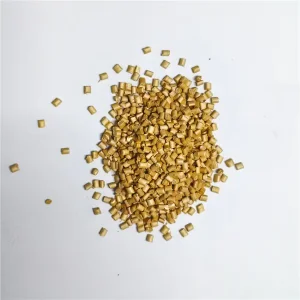
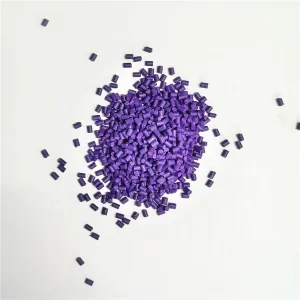
Precision-engineered PE carrier color masterbatches optimized for blown film, injection molding, and continuous profile extrusion with zero agglomeration.
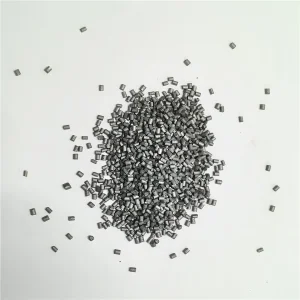
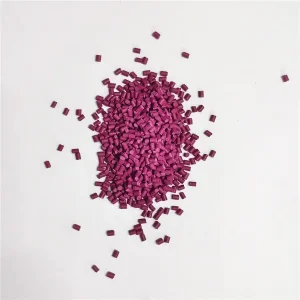
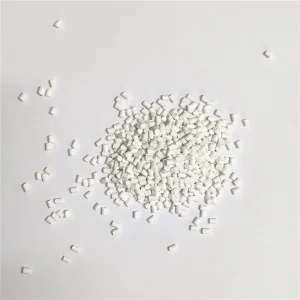
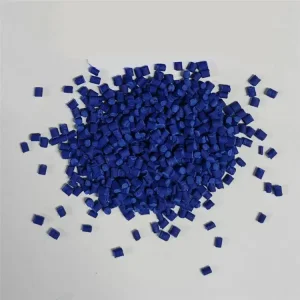
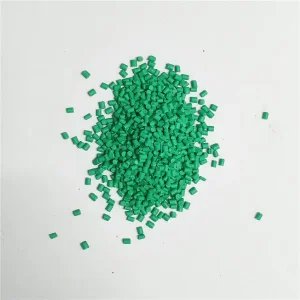
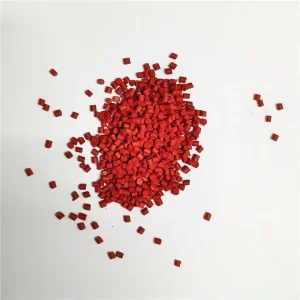
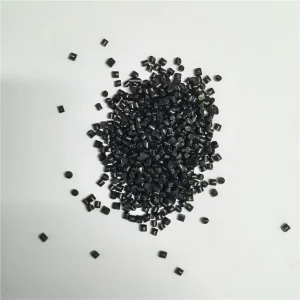
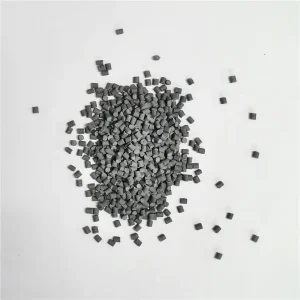
Why pigment dispersion efficiency directly governs downstream profitability, melt filtration longevity, and structural film integrity in polyolefin processing.
In modern high-speed polyolefin extrusion lines, raw inorganic pigments (such as Titanium Dioxide $TiO_2$ or Carbon Black) and organic dyes naturally form hydrophobic micro-agglomerates due to van der Waals forces. When improperly dispersed, these clusters cause melt pressure spikes, screen pack blinding, and microscopic pinholes in thin blown films. A true High Dispersion PE Masterbatch mitigates particle clustering down to sub-micron scales ($<0.5 \mu m$).
The carrier resin serves as the chemical bridge between the colorant concentrate and the base polymer substrate. Utilizing virgin linear low-density polyethylene (LLDPE) or high-density polyethylene (HDPE) with engineered Melt Flow Indices (MFI ranging from 8 g/10min to 45 g/10min), our formulations ensure instantaneous physical wetting and thermodynamic compatibility, eliminating phase separation during molding.
By achieving optimal pigment loading up to 50% without compromising melt shear flow, converters report up to a 38% decrease in scrap rates, reduced dosage requirements (let-down ratios as low as 1% to 3%), and elimination of surface streaks, flow lines, and heat-induced color shifting at continuous processing temperatures reaching 260°C to 300°C.
Evaluating supplier capability: How enterprise buyers streamline polyolefin raw material sourcing while guaranteeing international compliance and batch-to-batch repeatability.
Global procurement teams prioritize masterbatches with verified low Filter Pressure Values (tested under standard EN 13900-5). High FPV indicates coarse particles that rapidly clog extruder melt filters. Our high dispersion PE masterbatches maintain ultra-low FPV ($< 0.8 \text{ bar/g}$), guaranteeing uninterrupted extrusion runs across multi-layer blown film rigs.
Sourcing managers must navigate stringent international safety frameworks. Formulations must strictly comply with RoHS 3.0, REACH SVHC, FDA 21 CFR 178.3297 for food contact, EN71-3 toy safety standard, and EU Directive 10/2011. Heavy-metal-free and low-VOC guarantees are non-negotiable prerequisites for modern supply chain qualification.
Outdoor polyolefin applications—such as agricultural greenhouse films, HDPE pressure pipes, and stadium seating—demand lightfastness ratings of Blue Wool Scale 7-8 and Heat Resistance thresholds up to 260°C–300°C without color degradation or polymer backbone scission.
| Performance Parameter | Standard Masterbatch | Jiazhou High Dispersion PE Masterbatch | Industry Impact & Benefit |
|---|---|---|---|
| Pigment Loading Concentration | 15% – 30% Loading | 40% – 75% High Concentration | Reduces let-down ratio (LDR), lowering logistics & inventory costs by up to 25%. |
| Filter Pressure Value (FPV) | > 2.5 bar/g (High clogging) | < 0.6 bar/g (Ultra-clean) | Prevents screen pack blowouts, extending machine uptime by 300%. |
| Thermal Stability Rating | Up to 200°C – 220°C | 260°C – 300°C Heat Resistant | Eliminates color degradation in high-temperature engineering injection molding. |
| Color Variance (Delta E) | Delta E > 1.5 (Noticeable shift) | Delta E < 0.5 (Spectro-Matched) | Guarantees exact color consistency across multiple factory production batches. |
| Dispersant Chemistry | Generic Recycled PE Waxes | Functionalized Synthetic Coupling Waxes | Prevents surface blooming, migration, and printing ink adhesion failure. |
Deep dive into twin-screw co-rotating extrusion dynamics, surface energy modification, and futuristic polyolefin carrier chemistry.
Our state-of-the-art twin-screw extruders feature customized L/D ratios (Length-to-Diameter up to 48:1) equipped with specialized kneading blocks and reverse shearing elements. This multi-zone compounding regime subjects pigment particles to intense hydrodynamic shear stress, systematically breaking primary agglomerates into uniform nanoscale dispersions.
Inorganic pigments possess polar surface chemistry that naturally repels non-polar polyethylene chains. We introduce advanced titanate and silane coupling agents that chemically passivate pigment particle surfaces. This organophilic surface modification drastically reduces interfacial tension, promoting complete encapsulation by the molten PE matrix.
As the global plastics sector transitions toward circular economy models, our R&D roadmap integrates PCR (Post-Consumer Recycled) PE carriers and bio-based polyethylene matrixes. Furthermore, we are pioneering low-dust micro-pellet technologies ($1.5 \text{ mm}$ size) to improve automated dosing accuracy in smart Industry 4.0 factories.
Tailored high-dispersion masterbatch formulations designed for rigorous mechanical and aesthetic requirements across diverse global processing technologies.
Specially formulated for express courier bags, shopping bags, and agricultural mulch films down to 8 microns thickness. Ensures total opacity, high tensile strength, and zero pinhole formation during high-speed film blowing.
Provides high surface gloss and dimensional stability for daily consumer goods, food packaging crates, automotive interior trims, and industrial caps/closures. Zero warpage or sink mark distortion.
Delivers exceptional Carbon Black UV protection for PE80 and PE100 municipal water/gas pressure pipes. Ensures smooth internal wall finishes, reducing hydraulic drag and preventing environmental stress cracking (ESCR).
Engineered with pristine dielectric properties and thermal oxidation stability. Protects telecommunications and power cabling jacketing against harsh outdoor weathering and thermal aging.
16 Years of Masterbatch Manufacturing Mastery — Combining Advanced Compounding Automation with ISO Quality Engineering.
Located in Changzhou, Jiangsu Province, our modern 6,000 square meter factory facility operates 10 automated high-torque twin-screw compounding lines. Our plant achieves an annual production capacity exceeding 20,000 metric tons, satisfying large-scale global OEM supply requirements.
Our quality control laboratory utilizes computerized American Datacolor 850 benchtop spectrophotometers to evaluate color tolerance. We guarantee a strict color variance limit of $\Delta E < 0.5$ compared to standard Pantone, RAL, or customer-provided physical target chips.
Backwards-integrated color science teams formulate specialized color matches—including metallic silver, pearlescent gold, fluorescent, and deep jet black—within 3 to 5 business days, complete with sample swatches and physical extrusion test reports.
Ensuring seamless international procurement through flexible packaging, international customs clearance documentation, and field engineering support.
Masterbatches are packaged in multi-layer heavy-duty moisture-proof aluminum-foil valve bags (25kg net weight) or 1,250kg bulk jumbo sacks, protected by vacuum sealing and heat-shrink palletizing to prevent moisture absorption during maritime transit.
Every shipment is accompanied by a batch-specific Certificate of Analysis (COA), Technical Data Sheet (TDS), Safety Data Sheet (SDS / MSDS under GHS standards), and certified heavy metal test reports for friction-free customs clearance.
Our polymer process engineers provide worldwide remote and on-site troubleshooting—helping technical directors optimize extruder screw profiles, adjust melt temperature zones, and eliminate processing defects in real time.
Expert technical insights regarding PE masterbatch selection, dispersion mechanics, and processing optimization.
Standard PE masterbatch often utilizes low-cost filler waxes and conventional single-screw mixing, leaving pigment particles partially agglomerated (sizes $> 5 \mu m$). High Dispersion PE Masterbatch undergoes high-shear twin-screw compounding with specialized coupling agents, breaking pigment particles down to sub-micron scales ($< 0.5 \mu m$). This guarantees lower Filter Pressure Values (FPV), prevents film pinholes, increases tinting strength, and allows lower let-down ratios.
The carrier resin's MFI should closely match or be slightly higher than the base processing polymer to ensure fast, homogenous melting. For blown film extrusion (LDPE/LLDPE), an MFI of 10–20 g/10min is typical. For injection molding, higher melt flow carriers (20–45 g/10min) are recommended to facilitate easy mold filling without causing flow lines or structural weakness.
Yes. Formulations with high pigment concentration (e.g., 50%–70% pigment loading) require significantly lower addition rates (let-down ratios of 1%–2% vs 4%–5% for lower quality grades). This lowers per-ton colorant expense, decreases freight costs, reduces storage footprint, and minimizes machine downtime caused by frequent screen pack changes.
All masterbatches produced by Changzhou Jiazhou Plastic Products Co., Ltd. are certified under ISO 9001:2015 quality management systems. Our formulations comply with EU RoHS 3.0 (Directive 2015/863), REACH SVHC regulations, FDA 21 CFR 178.3297 food contact safety, and EN71-3 toy safety requirements.
Pigment migration occurs when low-molecular-weight dispersants bloom to the plastic surface. Jiazhou utilizes high-molecular-weight reactive dispersants and organophilic surface coupling agents that permanently lock the pigment matrix inside the polyethylene lattice, guaranteeing zero migration, non-bleeding performance, and lightfastness ratings up to Blue Wool Scale 8.
Browse our factory-direct polyolefin masterbatch portfolio engineered for blown film, injection molding, and profile extrusion.